
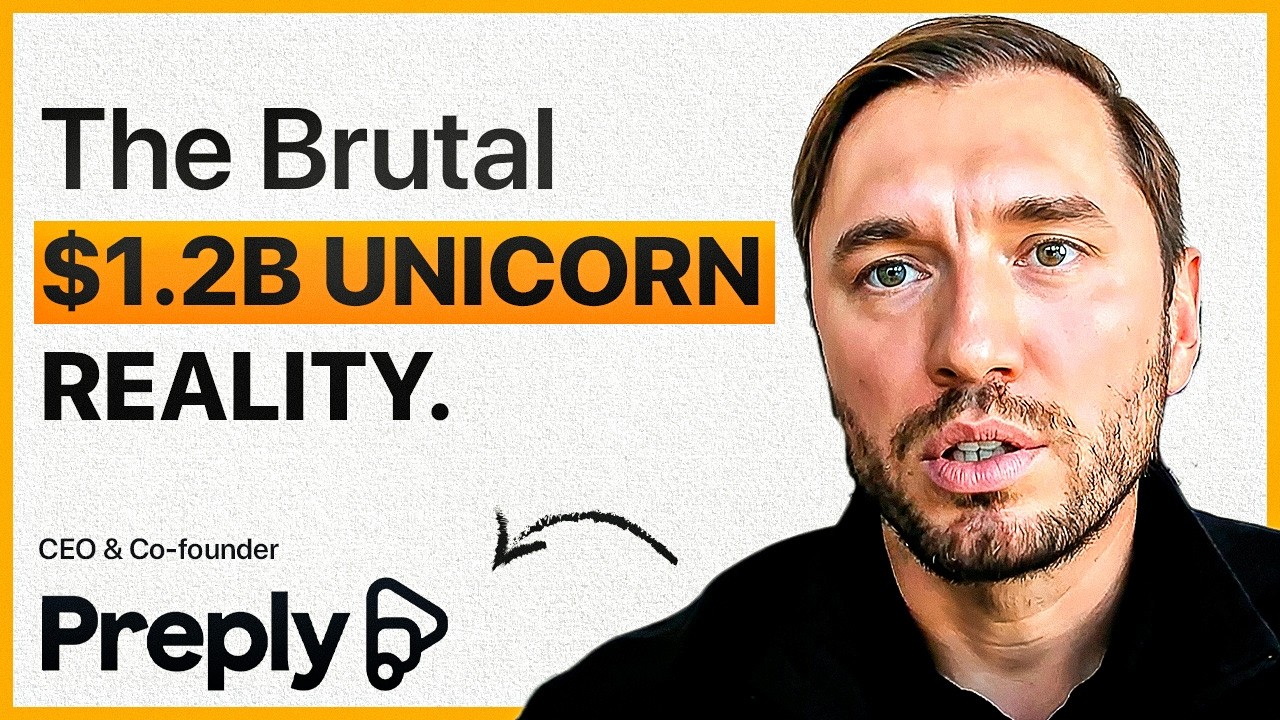

Intro0:00
The first thing that we think about with companies, you know, the founders must be amazing, but the reality is: PMF, good timing, and a bit of luck, it really changes everything. The only reason that I'm the founder of Airalo is because I was at theright place, at theright time, and I got a bit lucky.
And a big mistake that I did as an early founder was—
Ahmet Bahadir is the unlikely founder.
Who went from "accidental telecom guy" to building the go-to global connectivity platform used by millions.
And now he's revealing what modern capitalism is missing. And why human stories matter more than any strategy.
I was spending our money in an insanely wrong way. That's when I realized, man, we are losing around $200,000 every single month, andright after, COVID actually became a thing. Nobody really knew what was going to happen. There were no sales.
No one was going to invest in a travel-related business. And I actually dealt with a lot of panic attacks, like, constant panic attacks. It was a super tough time. But nevertheless, we got through it because we were surrounded by good people.
And I think that's so important: the success of kind people matter more than ever. In a world of hyper-tech bros trying to eat the world, and just seeing everyone as numbers, "Hey, we need to fire 10,000 here, 30,000 here," you are so profitable already.
Why? Your statistics mean nothing to an individual who is trying to pay their rent, who is struggling with a son who has leukemia, who has just lost his father or mother. We need to show the world that a bunch of common people can create uncommon results.
Every individual's story matters. And when people feel this, you achieve the most important thing for humans, in my opinion, which is.
Bahadir, welcome to the podcast show. It's great to have you here.
Thanks so much. Thanks so much for having me, Ollie. I appreciate it, appreciate being here.
So we've known of each other for quite a few years now, but actually this is the first time we're meeting, and what an amazing journey Airalo has had in the last few years. But we'd love to go back to the early days.
Founding Moment2:02
What was the kind of founding moment for starting, you know, basically this telecoms company and taking on the Goliaths out there?
Um, well, I— I always define myself as an accidental telecom guy. I had— I had— I had very little knowledge on telecoms, I would say. You know, I'm— I'm pretty much, I guess, the usual hustler, you would call it.
And as far as I remember, probably since 19 years old, I've been just hustling and— and building lifestyle businesses, failing 80% of them, maybe 90% of them. So the whole journey was kind of building up to building Airalo.
I wouldn't— I wouldn't say that my knowledge of telecommunications, in a sense, brought me here, but just a series of events, a chain of events. One business leading to another, one business leading to another, another leading to another.
And eventually me seeing the pain of connectivity for a whole different industry, which I'm happy to go, you know, deeper into, which is the maritime industry. It led me to eventually build Airalo, I would say. But again, I'm— I'm— I'm— I'm merely an accidental telecom guy, so I'm not— I've not been a telecom person all my life, if that makes sense.
Why did you want to go down this route? I mean, not every— I think you're the first founder I've ever met who wants to build a telecoms company. But actually, this is a bit more of a personal story,right?
You were both working with a bunch of sailors, and as we know, when you're at sea, getting connectivity is super hard. So how did you, you know, figure out there's a huge market here potentially?
Yeah. So the— the business I was doing previously was— it's called a ship-supply business. And I pretended to have a global company back in the day. I named it— I named it VOSCO. VOSCO basically stands for World Ship Supply Company.
So basically what I did was, I built a ship tracking system where I would see every single ship in the world, whether they're a cargo ship, whether it's a tanker ship. I would see every single ship heading to any country in the world.
And— and— and through satellite, through telex messaging, once I see the ETA of a ship, of a vessel, I would simply send the ship captain a message. So the ship could be going to Port Santos, Brazil, or Yokohama, Japan, or it could be going to Immingham, UK.
It could be going to Richard's Bay, South Africa, Istanbul, Turkey, doesn't matter. Wherever the ship goes, I would send the captain a simple question: "Captain, you are heading to Santos, or you are heading to Busan, Korea, and do you need any provisions, any bonded stores?"
Basically, these are potatoes, tomatoes, frozen meat, drinks. You know, the things that we all need, but the ships need them in bulk because there are 25 to 30 sailors on every ship. And what I did was, I built a warehouse network.
Imagine Uber Eats, imagine Foodpanda, but imagine it for the basically warehouses at the ports of the world. So when the captain gives me the order, I will have this order, this much tomatoes, this much potatoes, this much meat, and it will usually be a list around $10,000.
And I will simply pass the list to the warehouse in that country, and then the warehouse will deliver everything to the ship. They will do everything commercially, and at the end of the month, I will get my commission.
So I did this with hundreds of ships globally, and I— I did this with a lot of warehouses. Now, one funny thing about this is, the ship captains never like dealing with, I would say, middlemen, in a sense.
Like, "Hey, I will be in Busan, Korea eventually," they will think. So I can actually find the actual warehouse and give my orders at the port. So nobody would like someone sitting in Turkey, in his parents' home, with his laptop, trying to broker a deal between a Korean ship supplier and the ship.
I had— I had no business in this, basically. I was sitting in Turkey. So what I will do is, you know, as an entrepreneur, I will pretend to be 60 different personalities in 60 different countries. So I will be John in Singapore, I will be Veronica in Brazil, I will be Michael in the United States.
So I had a lot of personalities. And— and I did this business for some time, and I supplied many ships globally in many ports. What would keep happening is, every ship captain would ask me the same question in every port they go to: "Hey, thank you for the tomatoes, thank you for the potatoes.
Could you arrange a SIM card so that we can have connectivity?" And I realized, wherever they go, these sailors, they needed connectivity because they cannot use their roaming. They are literally traveling the world for 9 months and going back home for 3 months.
These are sailors from the Philippines, Bangladesh, India, you know, Myanmar. And— and what I did was, what I realized was, connectivity is a huge pain for the maritime industry. We have 1.7 million sailors globally traveling constantly, and yet they have not solved their problem.
So that's when I started looking into telecommunications. I wanted to see if I can make a global SIM card for the maritime industry. Something that is only for the seafarers. A SIM card, a physical SIM card, that works all around the world.
And— and— and I was lucky because I already had a warehouse network globally, which means I could distribute these SIM cards very easily at every port in the world. So I studied telecoms. I remember paying someone via PayPal $1,000 to give me a crash course on roaming and how SIM cards work, how telecommunication— just, just a couple of questions I had in mind.
And I found this person online, and I said, "Hey, can I have consultation? I have— I want to do a business, but I have no idea how it works. I have no idea how SIM cards work. I have no idea about roaming, so I would like to learn a little bit about this."
So I paid this person, he gave me a couple of pointers, and then I eventually launched a global SIM card business. And I sent those SIM cards, these global SIM cards. That business was called SIM4CREW, and I— I— I distributed it through the warehouses globally, and it sold like hotcakes, Ollie.
I was so surprised. I knew it was a pain. I just didn't know that every single ship captain would start ordering, "Thank you for the tomatoes, thank you for the potatoes, and we would like to buy 25 SIM4CREW cards."
Everywhere, at every port, I was selling these SIM cards like hotcakes. So to come to the Airalo part, I did that business. I actually eventually quit the potato-tomato side of things because the telecom side was too much fun.
It was a very small item, and there was the beauty of top-ups, there was the beauty of recurring revenue. So I figured that, why don't I build a telecom company just for sailors, you know, that— that— that could actually work.
So I abandoned, in a sense, the potatoes-tomatoes business, which was always one-off based on commission. And I— I wanted to go all-in building a telecom company just for the maritime industry, for the seafarers. It worked well for 2, 3 years, I would say, until I heard the news of Apple saying— and— and I remember this was 2018, September 28.
The day is very clear for me because I bought a lot of domain names on that day. Apple, on that day, 2018, 28 September, Apple said, "We are shipping the first eSIM-compatible phones." That was iPhone XS, XS Max, and XR, if I'm not mistaken.
So these were the very first eSIM-compatible phones that were being shipped by Apple. And when I saw that, I— I had what you call— I'm not saying I'm an innovator, but I had— I had, I guess, what you call an innovator's dilemma.
And I thought, if someone comes up with Amazon for eSIMs, no one is going to buy these, you know, slightly more expensive physical SIM cards with the friction of logistics. No one is going to pay for them. People are just going to start buying eSIMs country by country.
They will just download it instantly. And I knew that someone is going to come for, you know, with Amazon of eSIMs. I thought, okay, that should be me. Why am I worrying so much? Why don't I try to see if I can build the Amazon for eSIMs?
So this is how I kind of killed my own business, which was SIM4CREW, and then I decided to go all-in with the idea of building, in a sense, a store, an Amazon, a— a— a marketplace for eSIM connectivity.
And that's pretty much how Airalo came to life.
This is amazing. Okay, so you found this person online, you figure out there's a market, September the 28 is going to be probably, you know, the date you remember for the rest of your life. But also, it feels now— I mean, I remember, like, when I had a physical SIM card, people didn't use SIM cards anymore,right?
So it's almost just a game of luck. Like, you just got the marketright at theright opportunity.
Yeah. This is— this is very true. I think I have— I— I have a very clear belief in this, and I don't want to come off wrong when I'm saying this. But I'm a big believer in the fact that
product-market fit and good timing and a bit of luck is pretty much what is needed. What I'm— what I'm saying is that I know— I know, like, the only reason, at least a big part of the reason that I'm the founder of Airalo and, you know, I'm the first person to build this, is because I was literally at theright place, at theright time, and I got a bit lucky.
It's not because I'm the most amazing founder. It is not because I'm the smartest person in the room. I actually think I'm not that smart. But the reality is, like, just PMF and good timing and a bit of luck, it— it really changes everything.
I always think about the way— the way this comes to me is always, you know, I look at Google. You know, Google is Google. We all use Google. And— and it's— it's— it's amazing. And— and— and then I think the first thing that we think about is always, you know, the founders must be amazing.
And then I think about it, and I look at it deeply, and I see that Google has 300 products that failed. 300-plus products that failed because the timing wasn't— so it's the same founders. It's the— in a sense, it's the same quality of people.
So why— why— why isn't there 300, you know, more unicorns when you think about it? So, I mean, my conclusion is always, you know, just— just being at theright time,right place, figuring out something that solves a problem, and again, a bit of luck.
I think— I think that's— that's pretty much how the stars align. And then— and then you get— you get lucky to build something that others could build also. It's— I— I didn't build Airalo because I'm the most special person.
Others could have built Airalo. I just happened to be at theright place at theright time. That's how I see it.
Telco Partners14:10
I love that. And you know, like, it's such a big frustration for travelers when they go traveling and they get charged these massive data roaming charges, $10, $20 a day, where like, screw you, like, big telecoms. Like, this is so unfair,right?
So yes, it's perfect timing, but— okay, so it's perfect timing, but you've also now got to start figuring out,right, not only do we— how do we get customers, but how do we start partnering with all of these network providers,right, globally?
Yeah.
How does that whole process work, and who are your first providers, and, yeah, how did that come about?
Yeah. I mean, eventually, it is— it is— it is— it's a— it's a— it's a— it's work. It's— it's— it's definitely work. There are— there are layers to accessing connectivity globally. So the first way to start this is that you go through an aggregator, which is not the best way, but it is, in a sense, the quickest way, a more expensive way, because you are dealing with a lot of middlemen.
But in a— that— that— that will be the easiest way. So there are layers of connectivity globally. Today, what Airalo does is, we are in a position with our volumes and with our brand power that we can actually work with telecom companies country by country.
So what we do is, we just go to every single telco, and— and— and— and we— we try to have very deep integrations with them. And— and— and that's— that's pretty much how it works. Now, the first telcos were— were super hard to acquire.
What happened, I remember, was in 2019, when I had the idea of Airalo, I attended a telecom event in Netherlands, and basically we had $60,000 from Antler, and I think I spent, like, $4,000, $5,000 on that trip. So I went to this— this— this— this event in Netherlands, and I remember there was this guy, and— and he still stalks my LinkedIn profile sometimes.
I never— I never confronted him about this, but I think— and he was someone in the telecom industry for some time, and, you know, and he— he— he's— he's a cool dude. Like, he looks cool, a handsome guy, you know, walks with confidence, and then there's me, you know, an accidental telecom guy trying to say hello to the telecom companies.
And I remember this guy saying, when I— when we had this little booth, he came to us and he said, "You guys look so cute trying to mingle with telecom companies and trying to find your place." Like, the way he talked to us was so— I— I— I guess I remember how bad it made me feel.
Like, he was basically trying to imply that you don't have a seat in this room. Like, this is— this is not your game board. This is not— like, like, you're— you're— you guys are just cute little kids trying to play this game.
And— and I think that— that really, like, I remember that really, you know, staying with me. But nevertheless, basically, I attended my first event, and I tried to convince telecom companies to give us connectivity. It was super hard because, you know, they need commitments, they need volumes.
They don't just entertain someone, you know, who is not from the industry coming and saying, "Hey, I'd like to get some connectivity from you." It's not— it's not— it's not something they just do straight away. But I was very lucky.
One telco said, "I think what you have has merit. What you are trying to do has legs, and I think this is going to be something. And we don't want any deposit from you. We don't want any advance payment from you.
I'm going to support you, and I'm going to do a pay-as-you-go model for you so you can use our connectivity and pay, you know, postpay. Use, postpay, use, postpay." That person really supported us when we first started because anyone we talked to says, "Sure, we need $250,000 deposit.
We need a $2 million commitment." That company, which I'm not going to nameright now, but they kind of made it easy for us to get the first connectivity. And today, they've become our biggest supplier. And I think— I think, like, the amount of revenue they made from us is just insane at this point.
And it all started with they simply believing and saying, "You know what? We are not going to make your life difficult like all these other connectivity suppliers. We believe in what you are doing. Just pay us when you have the money."
And they've been making probably hundreds of million dollars since that day. So— so yeah, that's— that's pretty much how you do it. But yeah, you have to talk to every telco. Today, that's what we do. We go to every telco, we talk to them.
And today, it's much easier, obviously. Today, they know who we are, they know our volumes, they see that we can bring them petabytes and petabytes of data. So— so the conversation is much easier.
I honestly love that.
But we— we never see— we— we— I mean, there's always a, in a sense, a love-hate relationship, I would say, with telcos. But I most of the time see telcos as allies because eventually they are our suppliers. We just— we just need to make sure we structure theright commercials so that— so that the end users can enjoy these— these eSIM packages.
I love that. In every founding story, you're always going to have, like, those negative people around you, maybe, you know, patronizing you, but you're always going to have, like, those first few people, like, the people who first supported you,right?
Did you have any, like, particular tactics and, you know, convincing skills that you just wanted to partner with these guys? Or was it really, like, just very much, "Hey, look, this is exactly who we are. This is our mission.
Give us a chance"?
Yeah. I think what works well for us, and as a company, I believe it is in our core, is that we— we come off as people who are— how should I say this? Like, we don't use any jargons.
We don't— we don't use any hyperbolic, you know, sales tactics. We are— we are super straight and super boring. At least I've been, historically. I've been super straight and super boring in my asks. No— no— no fancy words, I would say, or no whining or dining.
And I— I actually don't know how to whine and dine. I just know how to ask things in a very boring way and tell the story of what I'm trying to do in a— in the most genuine way that is possible.
Nothing more, nothing less. You know, some— whatever I believe. And I think that always works for us. We— we— we never say things that we don't believe. We never build, in a sense, constructs that are obviously constructs. We just say things as they are.
And this— this, in a sense, I would say, down-to-earth approach has always worked for us. So I— I— I don't think I ever had, like, a— like a flashy sales tactic or a convincing tactic to convince anyone. We just tell our story in a— in a— in a very straightforward way.
"Hey, this is what we are trying to build, and we genuinely hope it works, so we would really appreciate if you become part of this." And— and— and that's pretty much how we do our, you know, telco convincing or fundraising.
But everything— we just say things that we believe. I think that matters a lot. We never have any fancy constructs or any fancy jargons. Just say things that you believe, and it works for us.
Growth Hacks21:47
You know, we say it like, "It takes an amazing team to get to where you are today," but it also takes, like, an army of supporters,right, especially your customers. How did you go around going from, you know, just a few thousand customers, while today, you know, you guys are the largest eSIM provider globally, getting those first 1,000, 10,000 customers, it must be, like, just looking back, must be, like, so easy now.
Yeah.
But getting those first 1,000 customers, what were those tactics?
I think I tried everything. Like, I remember trying so many weird growth hacks. Just, like, first of all, I have an Airalo t-shirt. It says, you know, there's a— there's a message behind it. And I have 50 black— 50 black versions and 50 white versions of those.
And almost—
Send one to Bangkok.
Almost— I will. And almost all— all of the time, I wear those t-shirts. And— and I know— I know these sound, you know, like, not scalable today, but I would, like, in every elevator— that's one dumb tactic, I would say.
In every single elevator ride, wherever it is, whether it's in a hotel, whether it's in an office building, wherever, I would have two, three people trapped with me for the next 1, 2 minutes. I would pretend to be on the call every single time, and I would be like, "Yeah, yeah, I mean, look, I know, I know, I know.
I— like, this thing is called, I think it's Airalo or Alo-Alo, something like this. And— and basically, it's this eSIM thing. And, like, I don't— I'm not paying the roaming charges anymore." So I would pretend, like, I'm someone, you know, who just figured out what Airalo is, and I will— I will talk to people like this.
Or I would wear my Airalo t-shirts everywhere I go, and I would just, like, literally walk in front of people trying to put the message into their eyes. On Twitter, I— I created this— this was 2019. I created a lot of Tweet, you know, accounts, and those accounts would basically follow every tweet that mentions roaming and pain.
Like, every single time someone on Twitter mentions roaming, pain, roaming, not working, our accounts, and these will be like, you know, anti-roaming hero type of accounts. They would just reply to those tweets saying, "Hey, you know, sorry to hear this.
You know, have you tried Airalo?" So we would— we would, like, follow every single— try to find every single person who tweets about their connectivity pain on Twitter. Same on Instagram. So we did a lot of, you know, things that don't scale.
But, you know, some worked, some didn't work. I think the— the— the thing that worked really well once we had a little money to spend was influencer marketing. And I— I— I realized that one of the biggest mistakes, and I'm happy to talk about those mistakes, is that spending marketing money in the wrong way.
Theright way was, "Wait, this is not music, so I cannot just tell people to download Spotify," because in my case, I need to first teach people what music is. I cannot assume they know what eSIM is. Nobody knows what an eSIM is.
And I'm telling people to download Airalo, and those Facebook ads or Google ads are not working. And I'm— and we are thinking, "Why are they not working? Why is the cake $80?" Like, our— our AOV is $15. We are having cakes of $80.
This is insane. Until we really cracked influencer marketing. So our— our, in a sense, big break happened when we paid $5,000 to a YouTuber, and he talked about us, and we had an insane amount of customers signing up from his country.
And— and— and that's when we realized, "Okay, we need to educate people. That's what we are missing. People don't know what eSIMs are, and yet we are pushing Airalo to their faces." So we changed our whole strategy into being the educator of what an eSIM is.
Because imagine, this is 2019. There is only 40 million Apple phones out there with eSIM capability. Just— just— just think about the conversion rate to travelers who have an eSIM phone. It is so low. Out of 1.2 billion travelers globally.
And— and— and we are trying to find those people, that— that 2 million people that are traveling with an eSIM-compatible phone. So we decided to just— just take a step back and just start educating the market. And that happened, I would say, 80% through influencers.
And it really worked for us. That's— that's pretty much how we cracked the sales. And the word of mouth then has been just insane. Just— just insane. Like, people who shared each other what Airalo is, what eSIMs are.
I think that's what brought Airalo to where it is today, the word of mouth.
It makes sense. Like, with all this, you know, creative marketing, influencer marketing, like, I have quite a few friends who are travel creators, influencers, TikTokers. And when I see them partnering with you guys, I'm like, "Fantastic." When I see them not partnering with you guys and someone else, I'm like, "I need to make friends with them and connect you guys."
But also, it says it in the customer reviews,right? I think one of your previous episodes, you mentioned around, you know, it was a partner with Sequoia. You know, when you know when it's a unicorn or soon-to-be-unicorn company, you can see on the reviews, it just works.
And I— I'm going to say this.
Yeah.
I'm going to say this now, and you guys have not paid me to say this. I have been a big fan of you guys for some time, been using you, I think, for 3 or 4 years. Platinum member now, so that, like, shows just how much I've—
Oh, yes.
How much I've— I've used you. I just flew from
Bangkok to Oman, downloaded the local eSIM on— on the app before I flew, and as soon as I arrived in this country I've never been to before, automatically connected to the network. And I feel, you know, when people go traveling, they have 2 to 3 worries: data, are they going to miss their flights, and are their bags going to arrive on time?
The most important is data, and it just works.
Yeah. I don't know if it— if it— like, because this is something so big for me also. Like, the first time I was in a Sequoia class, that's something that really also stuck with me. They said, "The sign of a unicorn is when customers start saying, 'It just works.'"
And I actually started looking at our reviews the same way you mentioned, and I've seen this so many times in our early days. It just works. It just works. And I think— and eventually, I think that's what we are providing,right?
Connectivity is the— is— is the name of it, but we are really providing that peace of mind. You know, we are taking your— your connectivity pain away, and we are providing you peace of mind. Just the idea that when you land, you'll be able to call your taxi, you'll be able to open your documents in your emails and— and— and show it to whoever needs to see them.
The idea that you will not be stranded. It is— it is— it is— it is— it is something that every traveler needs. And— and I think that's eventually what we are providing. We are providing you peace of mind.
COVID Survival28:58
Let's talk about founder challenges. I know, like, every time a founder builds a company, they're going to have amazing days, they're going to have okay days, they're going to have bad days, and they're going to have, like, panic days.
I remember vaguely when you guys had just raised one of your rounds, and then 2 weeks later, or even a week later, COVID happens.
Yeah.
And this is not a great time for any founder or any company in the travel company, in the travel industry.
Yeah.
What are you thinking, and how do you avoid panicking hourly?
Yeah. I mean, it was— it was— see, the thing about COVID is nobody really knew what was going to happen. Everybody thought it's a 2-month, 3-month thing, and it's going to go away. Nobody really understood, like, what COVID really is.
One— one interesting thing that happened to me, and if we have time, like, maybe just a small— small story on this one, is that one thing that happened with COVID, one thing that kind of worked for us was, in 2019, around, I would say, June, July, August, we had our Sequoia fundraising done.
So we had our seed money of $1.5 million. This was 2019, in a sense, middle of 2019. And my plan was very clear. 2020 June, I'm going to go for a Series A round. That was my plan. 2020 June, I'll go for a Series A round.
What happened was, in that 4 months, I would say, building to 2020, I was spending our money in an insanely wrong way. You know, a black hole spending of Facebook ads, Google ads. "Wait, people are not coming. The problem should be that I'm not putting enough money."
So then I put more money, and then we put more money. And a big mistake that I did as an early founder was, I was not observing our P&L. I was not looking at our expenses. I didn't see how terrible our Facebook ads expenses have become.
And then that's when I realized, "Man, we are losing around $200,000 every single month, and we only have $1.5 million in our bank account." Like, what the hell was I thinking? I had no idea.
Okay. 7 months.
What— so what happened was, Sequoia invited me to their office, and they said, "Let's look— let's take a look at the P&L." And then I showed them, and they said, "You realize you are going to be out of money in 2 months,right?"
And— and I'm— and I was like, "Yeah, I'm just— I'm just hoping things are going to be okay. I'm just hoping in the next 2 months, people will know more about eSIMs." But that's not how it worked. It's just me not really seeing the bigger picture.
So what happened was, by the end of 2019, I decided to go for a Series A round. So I was planning 2020 June. Instead, I said, "You know what? 2019, December, let's go for a Series A round." And we convinced Rakuten in the next month or 2, and Rakuten basically decided to put, you know, with other investors, $5.4 million Series A into our account in March 2020.
Andright after, COVID actually became a thing. If I had enough money, if I didn't spend the money in the dumbest way possible, I would have more money. I would confidently wait for the middle of 2020, where COVID would be a real thing.
No one was going to invest in a travel-related business. You know this. Nobody was going to even listen to us. "Hey, travel connectivity business." In the middle of COVID, no thanks. But seriously, when— when I spent the money in the dumbest way possible, we ran out of money so fast that we were forced to raise earlier, which kind of made sure we had enough money in our bank account during COVID times.
And that's literally what took us through COVID. There were no sales. Nothing was happening. Like, our stripe line was down to zero. People were not traveling only. Like, I could give them millions of free eSIMs, and they wouldn't be able to use them because nobody was traveling.
So we found that
we just need to go through this. We just need to power through this. And we were so blessed, so lucky that our war chest just got filled, literally before COVID. And they— that gave us such an unfair advantage because for 2 years, nobody even dared to think about building a travel eSIM business.
Nobody even— nobody even could imagine going into such a business. And yet we were in there. We had a chance to fix all the broken parts with $5 million in our bank account. So we just powered through COVID, I would say.
It was a super tough time. Super tough time. I had— I remember clearly, I had $36,000 before the Rakuten funding came in. $36,000. That was the last money we were supposed to pay the suppliers, the— you know, the— the salaries.
And we just had $36,000. The last money. And I'm just waiting for the Rakuten money to come in. And luckily, one of the angels, who was also a pre-seed angel, he said, "I'm going to send my moneyright now.
You know, pay your— pay your debts, pay your suppliers." And that's— that's kind of, you know, how— how— how it happened.
I— I'm getting the sense in this story that so much of this is all about luck, but having just amazing people by your side, the first telecoms provider you had, your first team members, your angel investors, your investors, but nobody saw COVID happening.
And I'd actually like to go inside your brain, inside, like, team environment back then. Were you guys freaking out? Were you thinking of, "What else— what other businesses can we do?" Because no one's traveling.
Yeah. I mean, I— I think we were freaking out. But I think what we were trying to do eventually was, we did start a war on waste. As in, look, every— every single thing that is not necessary today, like, or— or it feels vaguely necessary, we are going to cut it.
We had to be super strict to make sure that, you know, we are just getting by, in a sense. So— so we did declare war on waste, and everyone was on board with it. And— and, you know, is there— is there an unnecessary subscription that we wouldn't mind because it's $60?
Let's cancel itright now. Like, we— we decided to make sure, you know, we— we made sure that we don't spend anything unnecessarily. And— and— and— and that's— that's pretty much how we— we tried to— we tried to get through this.
But it wasn't a tough time. It was a super tough time. And— and— and I mean, because the— the— there were no sales happening. And that's— we— we've reached 100K revenue in our 4th month. And— and we thought it's just going to go the hockey stick that everyone talks about.
It's going to happen with Airalo. It's 10,000. It's 20,000. And it's— it's happening. You know, especially after the influencer, the— the revenue is just going up, and then boom, it just— it just goes down overnight. We were very stressed.
And I actually— I dealt with a lot of panic attacks back then, like— like constant panic attacks. The emergency doctors became my best friends. I would just— I— I— I got in a state where I wouldn't even see the doctor.
I would just feel comfortable inside the emergency room. Like, that kind of became my routine trip. Whenever I'm feeling overwhelmed during those times, people have expectations, investors have expectations, my family has expectations, I would kind of say, "Let me take a trip to the emergency room, sit there, breathe, watch people," and I would just feel better and— and, you know, go back to— go back to building.
But it was a super tough time. But I mean, we— we got— we got— we got through it because I think we were surrounded by good people, people who understand. And that's— that's what I mean by when I say, you know, remember in the beginning I said, you know, people who say things, you know, that they mean.
I think— I think that's very important for us. You know, being surrounded by— I always say Airalo is a bunch of common people putting out uncommon results. And— and we are big believers in this. And— and that's the type of people we always try to have within Airalo.
A bunch of common people putting out uncommon results. Good people, kind people, you know, people without big jargons, without big— and they— they mean what they say. And that's very important, you know, because so many times, we say things that we don't mean.
And it's— and we don't even realize it. Like, think— think about it. Like, you know, like, you will see some— I mean, this— this may not be the best example, but you will see someone coming to you and preaching about religion, and they— they will say, "I am so sad for everyone who didn't accept religion."
The thing is, no, you are not. You are not sad for everyone. You are very happy for yourself. That's the thing. You are very happy for yourself. But in reality, you are really not sad for everyone. But just imagine how easy it is for us to just say things.
"I'm so sad for everyone who couldn't find— who don't believe in a religion." Are you really— are you really sad for everyone? So that's what I mean by— I mean, again, this is— this is just a simple example.
But my point is, we don't realize it, but we say so many things that we simply don't mean. And it's— it's— it's so easy to say things. And I think that's so important that you are surrounded by people who are just— who are— who are people that say things that they mean.
And we were very lucky, you know, getting through COVID. We were surrounded by good investors, good colleagues, good employees. And— and that kind of, you know, helped— helped a lot. You know, being surrounded by theright people. No assholes allowed.
That's— that works for us.
It's such an amazing story, you know. I mean, just hearing your personal story, and also just from what I've heard from other people who know you, people just think, to— to build a big company, yes, it takes grit, but also, you've just got to be a really nice person.
Human Stories39:19
And I feel like the best founders are great people, but they're just genuine. There's no BS behind it. They say it exactly how it is. Super kind. And they care. That's all it takes, really.
I mean, that— I mean, really think about it. Like, that's— that's something— that's something I— I think I'll die on this hill, as they say. That's something I care. Like,
I'm someone who has been scolded a lot in the past. My dignity has been broken a lot in the past. And I— I went through a lot of hardship. I— I'm not saying this to— to tell a sob story.
What this made me realize is that I think something that we miss, and something that capitalism misses eventually, is that
we are missing individual stories. And I think— I think that— and that's something we take very seriously at Airalo. Individual stories. The story of an individual matters so much at Airalo. And— and I have a personal beef with the whole idea of greater good.
You know, we always say, "If 80% is okay, it's okay." No, it's not. No, it's not, because statistics mean nothing to an individual. Your statistics, it means nothing to an individual who is trying to pay their rent, who is struggling with a son who has leukemia, who has just lost his— his— his father or mother.
Your statistics mean nothing to an individual. And yet we are generally okay with the idea of greater good. Greater good. This greater— we should do this for the greater good. This should happen for the greater good. I almost despise the idea of greater good because I feel like this is how dictatorships are built, because it's greater good for who is debatable.
Where I'm trying to go with this is that I think what capitalism misses eventually is that capitalism doesn't recognize people as mothers, as fathers, as someone who has a son struggling in the hospital, as someone who is trying to pay their rent.
And it's— and we miss those stories. And looking at my own past, I always wish that those stories weren't missed on my side. Like, I always wish that people could see the pain that I'm going through. So it's kind of a promise that I made to myself, that I will do my best never to miss individual stories.
Because individual stories matter. There's a— there's a Pakistani guy who works in my hotel. I— I live in a hotel. And— and he— he— he— he— he— he works here. He takes care of laundry. And I talk to him all the time.
This guy, smiling all the time, Ollie, like, smiling all the time. And I just learned that just a week ago— a week ago— his wife died. In Pakistan, his wife fell off a motorcycle, and his wife died. So, wait.
Your wife died one week ago, and you are here smiling at me. You are here still doing this because he's so afraid that he's going to lose his job. Because he's so— like, just think about the sheer pain of someone losing their wife and yet trying to smile into my face because I'm a customer.
That sucks so much. And— and— and this is— this is where I'm trying to go. Individual stories. See, capitalism won't recognize you as a grieving husband. It doesn't. It just doesn't. Because you have to be okay for the greater good,right?
And— and I have— I have a big issue with this, and I'm going to die on this hill. And that's what we are trying to do at Airalo. That guy's story, it matters. It matters a lot. A lot.
And— and— and— and— and that's what I'm trying to do at Airalo. Every individual story matters. Because we tend to forget. Companies tend to forget what people are really going through. And— and when you— when— and— and— and I gave this example before.
And— and— and— and I think what happens eventually with founders, or with investors, with companies as a persona— I've given this example before— is that they get to the, you know, the Maslow's hierarchy of needs. They all get to the self-realization stage.
It's a— it's such a soft, nice place to be,right? Self-realization. But most of the world is at the shelter, food, safety stage. So how companies behave, or how disconnected founders behave, or how disconnected investors who are at the self-realization stage behave, is that, "Well, I see, Ollie, you have a problem.
I see you are struggling, but did you watch the sky today? Did you watch the rainbows today? Dude, I am trying to pay my rent. Let's talk about my rent." And— and— and that's what bothers me. And that's where I have a huge problem with.
We— we have gotten so disconnected with the realities of the world where individual stories matter. People are going through a lot of pain. People have so much they want to talk about, and it's almost like they are not allowed to talk about it.
Because capitalism doesn't really care about your stories. It— it— it recognizes KPIs. It recognizes ROI. It recognizes efficiency, revenue. And— and— and nobody takes a— takes a step back and just goes like, "Wait. It's not that deep. This whole thing, it's not that deep.
Your— your ambition to— to— to— to make billions of dollars, it's not that deep. This— this whole efficiency concept, this and that, it's not that deep. This podcast, it's not that deep. Don't get me wrong. But everything eventually that we are trying to do, we are just trying to live happy lives and kind of be done with it.
But we make the in-between so difficult now. Unbelievably difficult, where we just ignore the things that shouldn't— that shouldn't be ignored, and we get obsessed with things that we shouldn't be so obsessed with. There's this disconnect with self-realization stage of, "Hey, you need to travel the world and watch the rainbows.
Everything will be okay." "No, sir, I'm trying to pay my rent. Thanks for the advice, but you are so disconnected from my realityright now. Do you have any idea what it means not to be able to pay rent next month?"
"You don't. And that's why your advice is, 'Well, you should travel the world. Exploring the world will give you a new perspective.'" Like, "Sir, again, I am trying to pay my rent. This advice doesn't work for me." I'm— I'm trying to wrap up here, but I think what we really care about at Airalo is every individual matters.
Not the greater good. Every individual matters. Every individual story matters. And when people feel this, when people feel recognized, you achieve the most important thing for humans, in my opinion, which is safety. Which is the feeling of psychological safety.
And I do like to think that's how our people think at Airalo. They know that their stories matter. They know that they are not KPIs. They know that firing is almost impossible at Airalo because I know how hard it is to go home to your wife, or your husband, or your kids, and try to explain to them that you don't have a job anymore.
It is a very undignifying, in a sense, moment to have. I had those moments. And— and I know what it feels like. And I'm hoping nobody in our company sees those moments. So when you give people that safe place, something happens in the company.
Your employee churn almost goes to zero. People love being part of it. And you don't have to micromanage anyone anymore, because everyone becomes their own police. Because everyone realizes one thing. In a world of indifference and hardcore capitalism, the success of kind people, empathetic people, compassionate people, matter more than ever.
In a world of efficiency, in a world of hyper-tech bros trying to eat the world, and just seeing everyone as numbers, "Hey, we need to fire 10,000 here, 30,000 here." Why? It's not that deep. Why? You are so profitable already.
Why do you need to do this? So in a world where we have become so indifferent to our stories and to our pains, I think it matters so much that kind people, good people, can play this game just fine.
And I think our people sees this. People of Airalo, they see that
we need to show the world that a bunch of common people can create uncommon results. And this culture, I like to think, works for us. You know, it's not an eat-the-world culture. It's a, "Let's do our best and show the world that a bunch of good people can play this game just fine."
And I don't know how we came here, but yeah. I think it's— it's a— it's a subject that— that I take so seriously. Again, I— I'll die on this hill of hearing individual stories versus the concept of greater good.
Wow.
But yeah.
There is so much to take in there. And thank you for sharing all of those. Like, it's— it also makes me think, okay, like, one— one of the major things about traveling is, you just see so many different perspectives on life.
And all of my friends who live in Europe, who haven't traveled to Asia, they haven't traveled the world, you know, they just haven't— they don't want to, or they just haven't had time to. And I'm just like, go and see the world.
Go and be stuck in the middle of India. Go to Pakistan. Go to, you know, I was in the middle of India a couple of years ago. These people have nothing. And we're complaining, like, we don't— our phone doesn't work.
I don't have any electric. Like.
And talk to them. And talk to them. And it's— and it's the beauty of travel. I— I have this tagline, like, always in my mind. Every connection starts with a conversation. Every connection starts with an eSIM. No, every connection starts with Wi-Fi.
No. Every connection starts with a conversation. When you talk to people, people in other countries, your world expands in such a way that you realize, "Wait, the media told me previously that I should be hating you. And now I know you, and now we talked, and I know your story.
You're a pretty awesome person. You have a pretty amazing story." It brings you so much closer. And all these walls, all these artificial walls that you build between you and everyone else, because someone else kind of told you to build those walls, they just disappear.
They beautifully disappear. And— and— and all these misunderstandings go away. Misconceptions go away. You go into another country, you meet those people, and you're like, "You're a bunch of really good people, and I think we can be friends."
So that's why I— I— that's— that's— that's— I think the most— one of the most beautiful parts of travel is that it— it— it connects you with people that you would never know. You know— you know they say, "Strangers are stories you haven't heard."
So they become not being strangers anymore, because now all these stories you hear, and then— and you actually start seeing the world with a whole different lens. And— and— and.
Ah, that's good.
That's— that's— that's why travel is amazing. And— and what we do eventually at Airalo, we just make sure you are connected during that travel.
I love that. Maybe to.
I love it.
Exactlyright. And maybe just one— one last thing on this angle. It's, I don't get people who book a Grab or book an Uber or whatever, they're always in the back of a— of the taxi of the car. I always love to sitright next to the driver because they have such interesting stories.
True.
I was just in LA, India, Pakistan, like, all these amazing places. And these drivers, like, they're so interesting.
True.
Some people are trying to go to medical school. Some people are trying to move abroad. Some people are just trying to pay for their kids. Some people have, like, 5, 6 kids.
Yeah.
They're just such amazing people at the end of the day. And as you say, every— every connection starts with a conversation.
Yeah. That is— that is true. And I agree with this.
Like this.
There are— there are so many individual stories out there. And every story matters, Ollie. Like, so much pain, so much good things, but there's just so many stories out there. And— and— and I think it's so important for us to just know that individuals matters, and statistics mean nothing to an individual.
So every individual story matters. And yeah, I— I— I love listening to stories, just like— just like you do.
Amazing.
I think— I think— I think there's so much beauty in— in human stories in general. And it— it— it— it humbles you. It really humbles you. You—
It does.
You— you start looking at the world in a— with a whole different perspective.
The Big Vision53:28
It does,right? Looking at the— the impact you guys have created, to— to finish off, the impact has been huge,right? Connecting millions of people together. But I feel like there is such a massive opportunity you guys can create and have a massive impact.
It feels like you're still just getting going. You know, you lost 2 years because of COVID, so really, you've only been around a few years. What's like the big.
Thank you.
What is the big vision? Where is— where are you guys going to go next?
I think the way I kind of put this in my own words is, I have this dream where every gigabyte used by someone globally comes from the Airalo structure, direct or indirectly. Which means you can be getting it directly from Airalo, or you could be getting it from your OTA, your airline, your fintech app, your small mama-papa shop.
Wherever you get connectivity, my dream is that, you know it or you don't know it, behind the scenes, there is the Airalo infrastructure. And there is the bigger vision that we have with Airalo. Airalo started as, I always say, like to say, a Spiderman.
We have a very visible form. It's an app. It's a website. I want to see if we can turn Airalo into Venom, more liquid, more fluid, everywhere, in— in— in— in— in every system. And this starts with building a global layer of connectivity between the raw connectivity of telcos and everything else.
Even Airalo itself plugs into this layer. So our, I would say, end vision is to build that layer that turns the raw telco connectivity into meaningful connectivity, not just for Airalo. Airalo becomes one company that plugs into this layer, but everyone who wants to provide and distribute connectivity.
So I would say the end vision is almost like a one-layer, one global network where Airalo is a customer of it. Airalo is, you know, plugs into it, but also your fintech app plugs into it, your OTA plugs into it, your— your messenger app plugs into it.
And— and— and that's pretty much the end vision. I want to— I want to— I want to provide connectivity for the world. At least make it more affordable and more convenient globally. That's the end game. Every gigabyte used by someone globally comes from Airalo, directly or indirectly.
And hopefully then, at the end, many more people can have great conversations and meet amazing new connections.
More connections, more conversations. Exactly. That's the hope.
That's amazing. Bahadir, this has been amazing. Such a humble conversation.
Thank you.
Thank you.
Thank you so much for inviting me.
This has been really, really amazing. And those of you, the audience who haven't tried the platform yet, go and give it a go. It just works. And it's one of the best platforms I use when I go traveling.
Thank you so much, Ollie. I really appreciate this time. Have a beautiful day, man.